
Iranian Artists Abroad Who Are Changing Contemporary Art

Iranian contemporary art has become one of the most powerful cultural voices of the global diaspora. From New York and Los Angeles to London, Berlin, Frankfurt, Brooklyn, and Washington D.C., Iranian artists abroad are not only preserving cultural memory. They are also reshaping the language of contemporary art itself.
Their work often carries the emotional weight of migration, exile, revolution, censorship, identity, gender, memory, and belonging. But it would be too simple to describe these artists only through politics. What makes them important is that they transform personal and historical experience into universal visual languages. Their work speaks to anyone who has lived between cultures, between languages, or between different versions of home.
Below are some of the Iranian artists abroad whose work continues to influence museums, galleries, collectors, and younger generations of artists around the world.
⸻
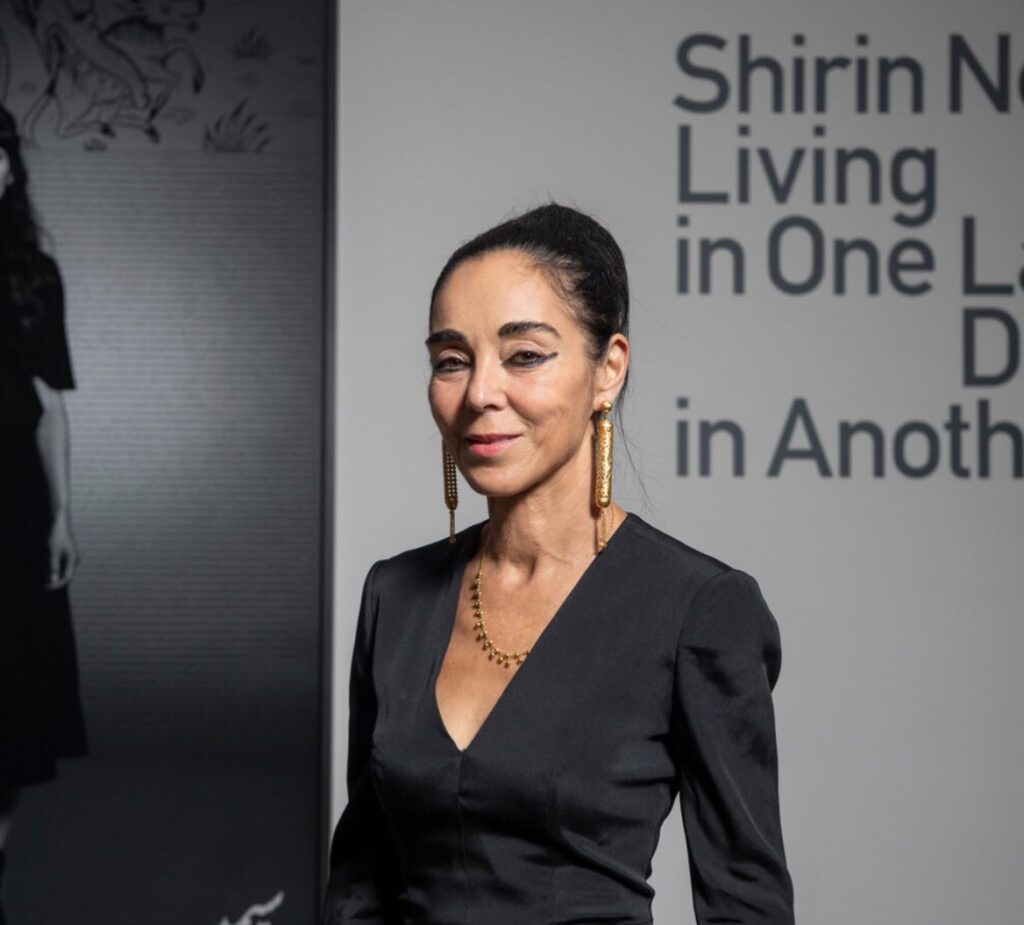
Shirin Neshat: The visual language of exile, gender, and power
Few Iranian artists have had the international impact of Shirin Neshat. Born in Qazvin in 1957, she moved to the United States as a teenager and later became one of the most recognized Iranian-born artists working in film, photography, and video installation. The Guggenheim notes that Neshat was sent to the United States in 1974, while Tate describes her as an Iranian photographer and visual artist living in New York City.
Neshat’s work is often associated with themes of femininity, Islam, public and private life, silence, resistance, and the psychological experience of displacement. Her famous photographic series Women of Allah placed Persian calligraphy over black-and-white images of women, creating a visual language that was at once poetic, political, and confrontational.
What makes Neshat important is not only that she brought Iranian women’s experiences into major Western art institutions. It is that she created an image vocabulary that many people now associate with contemporary Iranian art: black and white contrast, poetic text, the female gaze, and the tension between beauty and control.
⸻
Tala Madani: Satire, masculinity, motherhood, and absurd power
Tala Madani, born in Tehran in 1981 and based in Los Angeles, has become one of the most distinctive painters of her generation. MoMA describes her work as provocative, humorous, and disturbing, using painting, drawing, and stop-motion animation to examine themes such as patriarchy and xenophobia.
Madani’s paintings are instantly recognizable. They often show strange, bald, cartoon-like male figures in embarrassing, grotesque, or absurd situations. Her visual world is funny, but the humor is sharp. It exposes power, ego, violence, shame, and social performance.
Her work is especially important because she refuses to present Iranian identity in a predictable way. Instead of creating art that simply explains Iran to the West, Madani makes art that attacks universal systems: masculinity, authority, motherhood, shame, and the body. Her first major North American survey was held at MOCA’s Geffen Contemporary in 2022 to 2023, showing how central she has become to contemporary painting today.
⸻
Shirazeh Houshiary: Spiritual abstraction between Iran and Britain
Shirazeh Houshiary was born in Shiraz in 1955 and moved to London in 1974. She studied at Chelsea School of Art and continues to live and work in London.
Houshiary’s work is very different from the political imagery often expected from Iranian artists. Her paintings, sculptures, and animations explore perception, breath, silence, spirituality, transparency, and the invisible. Lehmann Maupin describes her practice as challenging perceptions of time, space, and materiality, often working with opposing states such as presence and absence, sound and silence, surface and depth.
Her importance lies in expanding what Iranian contemporary art can be. She shows that Iranian identity in art does not always need to appear through direct symbols such as flags, calligraphy, or political references. Sometimes it appears through rhythm, repetition, mysticism, and the search for the unseen.
⸻
Parastou Forouhar: Art, memory, and political resistance in Germany
Parastou Forouhar is one of the most important Iranian artists living in Germany. Born in Tehran in 1962, she studied art at the University of Tehran and has lived and worked in Germany since 1991.
Forouhar’s art is deeply connected to exile, memory, violence, and political critique. Her installations often use Persian script and decorative patterns, but the beauty of the surface hides darker subjects. Her well-known Written Room installations cover walls and floors with dense Persian writing, turning language into an immersive environment.
Kunstmeile Krems describes her as one of the prominent voices in contemporary Iranian art and notes that her work unites exile, personal experience, political reflection, and aesthetic clarity.
For the Iranian community abroad, Forouhar’s work is especially powerful because it shows how art can become a form of memory. It does not let history disappear. It asks viewers to look again at what has been hidden, beautified, or silenced.
⸻
Ali Banisadr: Painting chaos, history, and memory
Ali Banisadr was born in Tehran in 1976 and now lives and works in Brooklyn, New York. His biography describes him as a contemporary American artist born in Tehran.
Banisadr’s paintings are energetic, complex, and full of movement. At first glance, they may look abstract, but the viewer slowly discovers figures, crowds, battles, landscapes, and dreamlike structures inside them. His work often feels like history in motion: chaotic, beautiful, violent, and alive.
What makes Banisadr important is his ability to turn memory into atmosphere. His paintings do not simply illustrate events. They create a sensory experience of conflict, noise, migration, and transformation. For many diaspora viewers, this feels familiar: the past is not always remembered clearly, but it remains emotionally present.
⸻
Y.Z. Kami: Faces, spirituality, and the silence of looking
Y.Z. Kami, born in Tehran in 1956, lives and works in New York. Gagosian describes his practice as moving between portraiture, architecture, photography, sacred texts, and literary references. His work is also held in major public collections, including the Metropolitan Museum of Art, the Whitney Museum of American Art, the Guggenheim, and the British Museum.
Kami is best known for large-scale portraits with soft, blurred faces. His figures often look calm, distant, or inward. The viewer is invited not only to look at a face, but to experience the mystery of another person’s inner life.
His work is important because it connects Iranian cultural memory, Persian poetry, spiritual architecture, and Western portrait painting. In a fast and noisy art world, Kami’s paintings ask for slowness. They create a space for silence, contemplation, and human presence.
⸻
Kour Pour: Persian carpets, global identity, and cultural remixing
Kour Pour is a British-Iranian-American artist based in Los Angeles. His work is strongly connected to cultural exchange, migration, and the global movement of images and objects. Nazarian Curcio describes him as an artist whose work draws from Islamic patterning, Japanese woodblock prints, Korean Minhwa folk art, and other visual traditions.
Pour became known for large-scale paintings inspired by Persian carpets and textiles. But his work is not simply nostalgic. He uses carpets as symbols of trade, family memory, cultural inheritance, and global circulation. For Iranian diaspora audiences, his art is especially interesting because it treats heritage as something living. Persian visual culture is not frozen in the past. It can be remixed, reinterpreted, and placed in conversation with other cultures.
⸻
Raha Raissnia: Painting, film, and the power of analogue memory
Raha Raissnia was born in Tehran in 1968 and lives and works in Brooklyn, New York. Her practice combines painting, drawing, filmmaking, and performance. Xippas describes her work as existing at the crossroads of painting, drawing, and filmmaking, often connected to expanded cinema and the manipulation of time, space, frame, projectors, and screens.
Raissnia’s work feels like memory passing through a machine. She often uses analogue film, projections, layered images, and live performance to create works that seem unstable and mysterious. Her art does not give simple answers. It creates an experience of fragments, shadows, movement, and disappearance.
In a digital age, Raissnia’s commitment to analogue processes feels radical. Her work reminds us that memory is not clean or perfectly archived. It flickers, repeats, fades, and returns.
⸻
Avish Khebrehzadeh: Drawing, animation, and poetic displacement
Avish Khebrehzadeh was born in Tehran in 1969 and is based in Washington D.C. Her practice includes painting, drawing, sculpture, animation, film, and video projections. Ab-Anbar describes her work as exploring the power of figures and their narrative possibilities across multiple mediums.
Khebrehzadeh’s work often feels quiet and dreamlike. Figures appear in open spaces, sometimes fragile, sometimes mysterious, as if they are moving through stories we cannot fully access. Her experience of migration is not always shown directly, but it appears in the feeling of distance, uncertainty, and emotional suspension.
Her art is important because it gives visual form to the poetic side of displacement. Not all exile is loud. Sometimes it is a silence, a pause, or a figure walking through an undefined landscape.
⸻
Why Iranian artists abroad matter now
The global success of Iranian artists abroad is not accidental. Their work speaks to some of the most important questions in contemporary culture:
What does it mean to belong to more than one place?
How does memory survive migration?
Can language become image?
How do women artists challenge power?
How can beauty carry pain?
How does culture change when it travels?
Recent exhibitions continue to show the strength of Iranian diaspora art. ART IRAN: Falling into Language at Craft Contemporary presented nine diaspora Iranian artists using Persian alphabet, handwriting, text, and fragments as ways of staying connected to cultural inheritance across borders.
This is why Iranian contemporary art has become so relevant internationally. It is not only about Iran. It is about the modern human condition: migration, memory, identity, conflict, language, and the search for home.
⸻
Conclusion: A global art movement rooted in memory
Iranian artists abroad are changing contemporary art because they bring together personal history and global questions. They are not limited to one style, one country, or one political message. Some work with film and photography. Some paint. Some create installations. Some use Persian script. Some avoid obvious cultural symbols completely.
Together, they show that Iranian art is not a closed category. It is a living, changing, international conversation.
For the Iranian community abroad, these artists offer more than representation. They offer a mirror. Their work reflects the complexity of being connected to Iran while living elsewhere, of carrying memory while building a new life, and of turning cultural inheritance into something new.
That is why Iranian artists abroad are not only participating in contemporary art. They are helping redefine it.




 English
پاسخ ها